Get to know Mi. And companies like Mi. They are the danger. Good devices, good prices, new pronounceable branding tactics. They have the chemistry in place to change the market for good. Get ready. We are entering the next stage of the wireless business cycle. It's here. It's now. Work with it. Look for opportunities in adjacent markets. Content, services, the connection of things.
So, please do check out the new Xiaomi Mi Pad (Gigaom story), a very decently spec'd up tablet from the Chinese vendor. The Mi Pad has a 7.9-inch screen with 2,048-by-1,536 pixels, runs on an Nvidia Tegra K1 2.2 processor, has 2GB of RAM, an 8-megapixel rear camera, a 5-megapixel front camera, and a microSD slot. All this for $240 for the 16GB version. The tablet will be available in China this summer and I suspect other markets could follow.
Xiaomi (sort of pronounced “show me”) isn't a company looking to scrape some barnacles off of the side of the market. They are aiming for the top. Xiaomi's CEO, Lei Ju, said they “hope to put pressure on Apple.” Xiaomi is a company talking about bringing quality $50 smartphones to the masses. This is a company that is working its way global by spreading out across Asia.
So Apple, Microsoft, Samsung, Sony, others, please do remember Mi name.
No, you haven't heard the last of Mi.
The $240 quality-spec'd Mi tablet. Device prices are coming down, and a receding tide lowers prices for everyone.
(Yes, "Xiaomi" is sort of pronounced "show me" but soon "mi" will do fine.)
It's a bit sad to see the company where I worked for 16 years break apart. The Nokia I knew no longer exists. But there really are no surprises here. Clever companies know when it's time to move on.
All industries are special, sexy, and exciting. Until the day they aren't. Toasters, refrigerators, transistor radios, televisions, VCRs. They all had their day in the sun, but got covered in a thin, dull layer of boring. They became very everyday objects. Key players come, and key players go.
So, how much have the players in the handset industry changed? Completely! As I've pointed out before, not one single top-ten vendor from 20 years ago is still in the global handset business. They haven't just lost market share, they have given up competing in the industry. The big, fat hardware profits dried up so they just got up and moved on. Let someone else fight for the table scraps. That's the smart move so long as you have another watering hole lined up. (I'll say that the chunk of Motorola owned by Lenovo is a different company than the Motorola we knew.)
I remember five years ago when I first came across a top-ten global handset vendor named Xiaomi. Who? Some company few of us had ever heard of (and few knew how to pronounce) suddenly appeared as a top handset maker. I checked out their website. They had a portfolio of handsets a mile wide with features that must have been stuffed into devices with a plunger. There were phones with televisions, radios, touch input. There were sliders and colors galore. So what is Xiaomi up to now. Well, they are becoming a serious global smartphone company with sharp-looking gadgets. They even make bionic bunny rabbits.
But hey, it's getting crowded in here. Check out Huawei, another company name people can't quite pronounce, but matters a ton nonetheless. Huawei's goal this year is to ship 80 million smartphones. That would give them around 8% global share. And Huawei means business with a $300 million global marketing campaign.
So, what happens when Google brings out the advanced $100 smartphone? And Motorola/Lenovo the sub-$50 smartphone? What happens when good phones reach bubblegum-machine pricing?
KEY MOBILE TRENDS: commoditization, decling ASPs and margins.
Last month, NEC announced it was leaving the smartphone business and possibly the handset business altogether (see my entry: "NEC's Minolta Moment"). NEC was once a top global handset vendor and number one in Japan.
Now, according to sources out of Asia, it appears that NEC's compatriot Panasonic will exit the smartphone business as well. The reason is clear: on-going losses in a increasingly competitive market. It's time to move on. Barriers to entry keep coming down, and so are ASPs and margins. Panasonic's smartphone push was doomed.
In reality, the marketplace won't notice the void. Panasonic's share of the pie was so thin, this is hardly worthy of much reading. However this is another signal of how drastically the handset business has changed during the past decade or so. During the mid- to late-'90s, Panasonic was consistently a top-five global handset vendor, and was a market leader together with NEC in Japan. Expect more big-name brands to sneak out of the hardware business during the coming years.
One of the key trends in the smartphone business is the changing of the guard. The old-time players are leaving, new blood is coming in.
So here is news of a smartphone push from two Chinese players, China Mobile and Xiaomi. I remember Xiaomi well from a report I wrote back in 2007 when I was a Nokia employee, highlighting this growing Chinese player. One Nokia manager got back to me to assure me that top management knew all about Xiaomi and in fact, Nokia's CEO at the time marked the company as a top future handset competitor in the Chinese market. Commoditization was always a key concern, and drove strategic thinking long before most industry followers realized.
The China Mobile news is not unprecedented: operators have been introducing in-house branded handsets for decades. But China Mobile is not just some operator: it's the world's largest by a margin. With 740 million subscribers, if you want to gain real market share in China, you want to work with China Mobile.
China Mobile's two handsets, Android devices based on MediaTek guts, support TD-SCDMA, China's own 3G standard. Many vendors, including Apple, do not have TD-SCDMA models yet.
Note that China will soon have 300 million Android users, which is about the population of the United States. China in becoming Android nation.
China Mobile's first branded smartphones: Androids for $80 and $210
There's gold, there's silver, there's bronze, and then there's a patronizing pat on the back. Nobody remembers the fourth-place finisher.
In January of 2001, Sega announced they were leaving the game console business to focus on software. Although the company's Dreamcast console was considered by some to be the best gaming device ever made, the "rule of three" was a force too strong to fight: there was Sony, there was Microsoft, and there was Nintendo.
Sega's board of directors certainly had a difficult decision to make at the time. Sega's hardware was loved by devout followers, but Sega suddenly found itself competing not just against its compatriots Nintendo and Sony, but by newcomer Microsoft, a company that was known to have the patience of Job when it came to RoI.
Sega was in the fortunate position of having strong, established sub-brands, mainly Sonic the Hedgehog. Such well-known characters could port well to other platforms.
Within the coming quarters, some big-name smartphone vendors will begin to acknowledge the rule of three. This is conjecture on my part, but I believe the first will be BlackBerry, which will, like Sega, announce that they will leave the hardware business to become a third-party software publisher, providing secure enterprise messaging software and services via its now eponymous platform. There will be boos and jeers from the audience, but this isn't the breakup of the Beatles. This isn't a boxer getting out of the ring while at top: BlackBerry is fading fast with new product and platform iterations being greeting with indifference at best.
So for screaming BlackBerry fans, get mentally prepared for the Segafication of your love. BB will be IBMified, and there's not much that can be done about it at this point. The game is over for the iconic BlackBerry QWERTY device. Time for the next level.
MAJOR TRENDS: Cloud, HTML5, low-cost, commoditization, business-model changes
Back in February, I wrote about the next potential screen of death for Microsoft: Google's Chromebook. ("Is MS about to be Wanged?" Feb 25, 2013). At a price of $249, the Samsung-made Chromebook is an extremely capable, super sleek, cloud-centric laptop. It's solid and secure, low-maintenance and high-value. Set it and forget it. But now it's getting tough to ignore.
According to research firm NPD, Chromebooks dominated the low-cost segment of the U.S. laptop market during the half of 2013 with as much as 25% share. And according to Gartner, Chromebooks accounted for almost 5% of all U.S. laptop sales, up from around 1% — 2% in 2012. Considering that Samsung's low-cost Chromebook has been Amazon.com's top-selling laptop since December 2012, none of this is surprising. Americans are really learning that remote is the new local, and that thick-n-chunky, virus-friendly operating systems are a hindrance rather than a requirement to get things done.
But now as the Chromebook is going global, significant changes can begin to alter the entire market for PCs and really provide a boost to cloud-based ecosystems. Starting back in April of this year, Google began selling Chromebooks in 10 other countries. Chrome OS might soon reach escape velocity and become a platform worthy of a lot more respect from developers who'll accelerate the shift of their focus to web-based technologies such as HTML5.
Big changes are coming to the PC industry and Microsoft executives have certainly received the wake-up call: last week Steve Ballmer announced a corporate restructuring around "Software & Services." What's amazing about this new & improved Microsoft is the amazing parallels to the new & improved Nokia in 2006 when company executives promulgated its new organization focusing the future of the company on a P&L center called "Software & Services" to effectively compete against the GYM players (Google, Microsoft, Yahoo!).
During the coming years we will certainly see many more major company adjustments, some of them late and desperate last-minute attempts to acclimate to the on-going cross-industry shifts which are underway. Some platforms will be abandoned, some new ones will be adopted, smart players will make successful business-model transitions, and some big names will fade fast. Chrome OS is one of the lights at the end of the tunnel.
January 19, 2006: "Konica Minolta quits photo market. Konica Minolta said the market had become too competitive, and added it would sell its digital camera business to Japanese electronics giant Sony..." Source: BBC
Back at the beginning of 2006, despite a fantastically photogenic pedigree, Konica Minolta picked up and walked away from the camera business. Even with two strong brand names, both synonymous with photography, the company sank in an evolving industry until their market share was less than 3%. As competition increased and profit margins faded, the board of Konica Minolta made what must have been a very emotional decision: it's time to leave for greener pastures. Today Konica Minolta competes in the market for office copiers and printers. Photography is only part of the company's history now.
Industry shakeouts are nothing unprecedented in consumer electronics. Radios, televisions, telephones, computers. As average selling prices decline over time, the creamy profitable layer of the industry disappears, and the market self-corrects.
So now it's time to wonder which major smartphone vendor will be the first to surprise the industry with a "Minolta move" to an adjacent industry. Will it be Nokia, BlackBerry, Motorola, HTC, LG? This is conjecture, yes. But when market shares slip to the very low single digits, and only the absolute top-tier vendors are making a profit, we can be sure that some major market adjustments are afoot. It should be noted that many segments of the consumer electronics industry have historically followed a first-in-first-out pattern, with the early industry innovators vacating, leaving more room for the fast followers. (When's the last time you saw a Motorola car stereo?)
Several top-ten handset vendors from the '90s have left the business including Ericsson, Siemens, and a number of significant Japanese manufacturers. In the coming few years, there will be a similar pattern among smartphone vendors. Some brand names which are essentially synonymous with street talk will pick up and walk away. The enablers for extreme smartphone commoditization have quickly fallen into place: the hardware, the software, the distribution. The shakeout is going to happen. This will be an interesting development.
Minolta management, Jan 19th, 2006: "In such a changing world, profits for camera and photo businesses worsened in recent years, and it became necessary to drastically reform business structure for the further growth of Konica Minolta. Ever since we decided and announced restructuring guidelines of our businesses on November 4, 2005, we have been considering practical and detailed plan, and we would like to announce our decision made today as follows: we have decided to withdraw from camera business, such as film cameras and digital cameras..."
KEY MOBILE TRENDS: HTML5, commoditization, Foxconn.
Last week manufacturing powerhouse Foxconn confirmed plans to support Mozilla's Firefox OS with a series of white-labeled devices. If the announced intentions are followed through, this has the potential to impact the handset market in several ways, disrupting both the feature phone and smartphone players.
To begin with, Firefox OS could establish HTML5 as a legitimate mobile ecosystem alternative and slowly dilute native development environments from the bottom up. This won't be easy given the entrenchment that iOS and Android now enjoy. And new ecosystems are notoriously difficult to get going. But HTML5 has the power of the next web behind it, and Apple and Google are largest contributors to the standardization work.
The initial impact of Firefox OS would be felt in developing markets in South America and Eastern Europe, where Mozilla execs believe the platform has the best chances of growing a user base. Firefox OS-based devices are expected to reach significantly lower price points compared to current smartphones on the market. Retail prices of Firefox OS devices should come in below $100, and possibly sub $50 as some point given the smaller hardware profile.
At such low price points, feature phone vendors will need prepare for a consumer expectation shift. If Firefox OS is designed with the future in mind, most current feature phone platforms are descendants of 20th century technology. Vendors such as Samsung and Nokia will need to evaluate Firefox OS. Already Alcatel TCL, ZTE, LG, Huawei, and Sony have announced some interest in the platform. Dismissing Firefox OS could be like snubbing Android in its early days.
But now the Foxconn partnership should be a wake-up call to the industry. While Foxconn will not be selling their own labeled devices, their support should lower the barriers to entry for all vendors great and small to bring Firefox OS devices to market with a rather immediate effect on the feature phone market and lower-end smartphone segment. A trickle-up could put more pressure on smartphone vendors' mid-price ranges and hit ASPs and margins across the industry.
However, it should be made clear that historically, such mega mobile partnerships have a very mixed track record of success. I think back to 1999 when Nokia and Palm, two of the biggest industry names at the time, announced a partnership to create the mobile platform of the future. But despite lots of travel between California and Helsinki, there was nothing to show for the initial market excitement beyond an a press release. And Mozilla's is not the only new platform looking to establish itself. Fresh open-source mobile operating systems from Ubuntu, Intel (Tizen), and Jolla, among others, are appearing on the market.
Nonetheless, history is always on the side of change. Mozilla has shaken up the market before and chipped its way forward against Microsoft's Internet Explorer. History could repeat itself.
Sorry smartphone industry, you are not going to escape the fate of just about very other segment of the consumer electronics biz.
Relying on the value of the brand? That will certainly buy you some time. But when all devices look and act alike, pricing power fades, margins thin out, and market shares shift. Just look at the leading U.S. television set maker, Vizio. Who? That's my point exactly.
Yes, some guys you have never heard of are selling millions of smartphone enabled by IKEA-like chipset solutions that are assembled in optimized Chinese factories using off-the-shelf software. For years I was concerned about what I called the “supermarket brands,” that is, operator-labeled devices using white-box solutions. There were certainly some big hit devices with Vodafone and T-Mobile labels, more so in developing markets, but consumers did tend to migrate toward big brand names.
But when your neighbor, Frank, can start selling Android-based “Frank-o-phones” on Amazon.com, you had better find some more WOW to stuff into your devices. And some more adjacent business opportunity. For feature phone vendors, this is a trend which can really smart. Get ready to get down (in price).
What to do? Don't worry, I have solutions.
From MIT Tech Review Article:
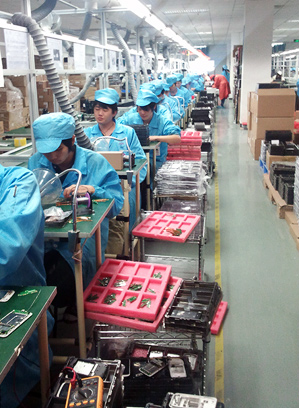
“Cheap phones: Workers assemble $65 smartphones at Guo Wei Global Electronics, one of hundreds of small Chinese factories now building mobile computers.”
KEY MOBILE TRENDS: commoditization, MediaTek, China
There are many smartphone vendors around the globe that I have never heard of. Most of them are based in China or India or other Asian markets. Here is one that is not. BLU Products. BLU who?
I don't think I had heard of BLU until earlier this month. According to the company's website, BLU was founded in 2009 "by Latin American entrepreneurs" and is headquartered in Miami. "More than one million BLU mobile devices have been sold in 25 countries throughout Latin America, the Caribbean and the U.S." These are not huge volumes for the handset market, but BLU seems to have found a niche.
BLU sells both feature phones and Android-based smartphones, all of which are certainly imported from a Chinese manufacturer. The newsworthy point here is the relatively low prices of their recently announced devices. One Android phone, called "LIFE Play," will sell for $229 on Amazon and other sites. Life Play is 7.9mm thin, has a 4.7-inch HD (720p?) screen, an 8 megapixel camera with 1080p recording, a 2 megapixel front-facing camera, a microSD expansion slot, and support GSM and HSPA networks. And apparently it's dual SIM. There's no LTE support, but this might not have much consequence in some target markets. This smartphone and other Android handsets recently announced by BLU are based on top of a MediaTek quad-core chipset.
Last week we saw a 5-inch, 1080p smartphone from a Chinese called Neo for around $145 in China. It's clear where things are headed.
BLU Products "LIFE Play," a dual-SIM, 4.7-inch Android smartphone for $229:
I have friends in Europe who bought unlocked, unsubsidized smartphones in the €80 range with tax. Small screens, little memory, child-like cameras, but brand names. The low-end of the smartphone market is coming down and absorbing feature phone market share.
And the market will keep shifting down. Here is a smartphone from Chinese maker Neo which is being called the “world’s cheapest 1080p smartphone." The Neo N003 has a 5-inch, 1080p display running Android on a quad-core processor and is expected to retail at 899 yuan (€112/$145).
This is a Chinese device for the Chinese market, but devices like this will have trickle down effects across many markets.
Nobody likes the smell of rotting animal flesh on their front porch.
KEY TRENDS: China, business development, services, long-term thinking
One of the more interesting – and impressive – business development stories of 2012 was Maersk's decision to slowly shift away from the shipping business (FT story) and into more profitable sectors such as oil services. At first read, a story about Maersk moving away from shipping is like hearing that IKEA will be getting out of the plywood-based furniture business. But for Maersk, this is an acknowledgement of a real and perhaps uncomfortable longer-term trend: although shipping volumes have been increasing, rising fuel costs and increased competition have been driving down freight rates and margins.
Does the theme music here sound familiar? Despite growth in global volumes, increasing competition is driving down average-selling prices and profit margins. Smartphones? Yes. So, at what point do vendors decide to sail for greener shores, where ever those may be?
When looking for larger market trends, take a good look back before looking forward: think long-term in reverse. Tangent lines can be very misleading. So, let's look back about six years to an era when the smartphone market was still in its youth. Nokia had greater than 50% of the smartphone market in early 2007 (and Symbian greater than 70%). To get an idea how powerful a position Nokia had then, take Samsung's current market share and Apple's current market share, add them up and then add a few extra points. That's what Nokia had. This shows the significant contrast to the current-day situation.
The market changes are amazing and nearly unprecedented across industries: not one of the top-five smartphone vendors from early 2007 (Nokia, RIM, Sharp, Motorola, and Palm) remains in the top five today, and some of those don't even remain. In addition, only 3.5 or 4.5 of the top-ten volume vendors of that era still remain in the top ten: Samsung (which dominates the market now but had less than 3% in early 2007), Sony (was "Sony Ericsson" thus the 0.5), HTC, RIM and possibly Nokia.
What should be highlighted here is the number of Chinese vendors who have entered the top-ten. Six years ago there were none. In fact, only two years ago there were none. But last quarter there were at least three (Huawei, ZTE, Lenovo) and it looks likely several more China-based Android vendors will join them in the coming quarters to satiate both local and global demand as the feature-phone market makes way for low-cost smartphones.
The market presence which some big smartphone brands had enjoyed has been shrinking at an accelerating pace and there are few solid or even delusional reasons to believe things will reverse. So now it's vital for those vendors to think forward five or six years and picture what the market could look like given current trends discussed above.
If such fading smartphone players aren't thinking about the possibility that they might not be in the business at all in five or six years from now, then they quite simply aren't thinking. For some vendors, it's time for reality to sink in: ignore long-term market trends and you'll go away.
Canalys' smartphone stats from 2006 highlights dramatic market changes.
About six years back or so, I recall speaking to one handset industry executive who predicted that trade prices of handsets from major vendors could never go below $25. That was the predicted floor for a handset from a top-tier vendor. "The battery and the box alone would always add $20 to BoM" was the reasoning. Yet here we are: for your consideration, please see the story about Nokia's new €15 handset aimed at developing markets. The Nokia 105 has a color display, up to 12.5 hours of talk time, is dust and splash proof, has a built-in flashlight, and even a few games.
So, the impossible has been reached. What's next? It's time to get mentally prepared for the €15 smartphone. It sounds impossible, I know. The display and processor alone will always add more to BoM than such a price. But as a scenario-building exercise, device vendors should think about the impossible. If the ASP of smartphones begin to reach bubble-gum machine levels, how will today's mainstream vendors cope?
Business development teams had better have their thinking caps on. Opportunities exist on the other side of the screen, but they aren't easy to find and often harder to monetize.
The smartphone market is reaching new lows. Are you ready?
Nokia's new entry-level device, the €15 Nokia 105:
Average-selling prices are reaching gum-ball machine territory.
...some thought continuation from my post about the "Chinafication" of the global handset industry:
Back in early 2008, in an internal report I wrote for Nokia management, I noted that a Chinese handset vendor named Tianyu had become a top-10 global brand. Even though I followed the industry closely, I had never heard of Tianyu before this. I decided to highlight the potential competitive threat of local vendors such as Tianyu who could appear out of nowhere in short order in vital growth markets.
I received some immediate feedback about my observations from one manager based out of Nokia's Beijing office: "Forget Tianyu: the company to really keep an eye on is MediaTek." That was a great tip.
Taiwan-based MediaTek may not be a direct competitor to smartphone vendors, but the company is an enabler of increased competition, lowering barriers to entry to the handset market. MediaTek offers complete chipset and software solutions allowing anybody with the desire to enter the handset business. It is MediaTek which enabled many of the "shanzhai" players to beat major vendors such as Nokia, Samsung, and Motorola to market with what appeared to be very similar-looking feature phones with risible brand names such as "Nokla" and "Sansung."
About two years ago, MediaTek announced their intentions of entering the market for smartphone ARM-based chipset solutions. The impact has been enormous: last year more than 110 million Chinese smartphones were based on MTK chipset solutions. This is greater than Qualcomm's market share in China.
MediaTek now offers solutions for both the higher-end of the smartphone market (quad-core) as continuing to enable very low-cost Android-based devices.
MTK has found its place in the mobile value chain. There are times when you shouldn't just look sideways to find your emerging competition, but at the bottom of the stack.
MediaTek's MT6575 optimized for low-cost Android 4 smartphones:
Back in the 1950s there were more than 60 American-based television manufacturers. By the 1990s, there were none. The stats for Europe are similar: most Western European countries had a national TV-set brand or two. Now few do. The hardware business went East. But the profitable content business stayed behind.
So, will the mobile device torch soon be passed East as well? And for good?
To me, there is no doubt that commoditization is the largest general trend in the handset business. The underlying software has taken center stage and service providers such as Google, Facebook, and wireless operators look at devices as little more than screens for their services.
Most smartphones and more basic handsets are already made in China regardless of the label. (I'm not sure if any smartphones are assembled outside of China.) But one of the key recurring themes during the last few quarters of sales as well as at CES 2013 is the growing strength of Chinese brands. Brands few had heard of just a few years ago are now making headlines across the globe: ZTE, Huawei, Lenovo, TCL, Coolpad, Xiaomi, Tianyu (K-Touch), Haier. And it looks possible that Chinese vendors could take half of the top 10 spots among handset market leaders within the coming quarters taking total global volumes greater than 25%.
About five years ago I was speaking to one Nokia executive about this subject. As he said at the time, "Chinese vendors make great copies... but they won't be making copies forever."
What will the mobile hardware business look like in 10 years? I suspect the writing is already on the great wall.
Ascending to greatness? The Windows Phone 8 Huawei Ascend W1:
It wasn't long ago when we were wondering when someone would come along with the sub-$200 smartphone. Now low-cost tablets are dripping onto the market. And usually when it rains, it pours.
Today ASUS introduced a low-cost tablet called the "MeMO Pad." It has a seven-inch, 1024 x 600 resolution screen and runs Android 4.1 on top of a 1GHz single core processor, and comes with 16GB worth of on-board storage. The hardware isn't the amazing part, it's the price: at $150 this is almost at the impulse-buying level. We've been seeing a number of decent tablets now at the $150 range.
Let's see if Amazon brings the price of its 7" Kindle tablet down a bit now.
Next, get ready for the sub-$100 tablet you can buy at the supermarket checkout. For any new competitors entering the tablet market, please keep devices like the MeMo in mind, and make sure you add a dash of WOW rather than introducing a MeToo.
Tablets as kids toys for $150? Yup. Let's call them kidlets. Tablet commoditization is reaching new heights.
Here is a child's tablet from Polaroid Corporation (which really has nothing to do with the long-bankrupt instant camera company). This tablet runs Android 4, has a seven-inch screen, customized apps for kids including a Nook eReader app, and appears to be a pretty tough device.
The inclusion of an eReading app could lead to some interesting content-based business models.
This isn't the first kids tablet. In fact, Toys R Us has been selling kids tablet computers for several seasons now. So, is this a sign that the tablet market is one to get into? Or perhaps one to get out of?
Will 2013 be a very unlucky number for many incumbent smartphone vendors? Will Amazon become the piranha of the industry, ripping away profitability flesh?
It's most tempting to look for your greatest competitive threats coming directly from existing competitors. But that's like looking for your lost keys under the lamp because that's where the light is.
So, rumors of an Amazon smartphone are getting loader and more serious. According to some sites including several in Taiwan, Foxconn has leaked info about an Amazon smartphone coming mid-2013. Such a device would likely run an Amazon-spiced version of Android, but no real solid spec details were included.
The price of such a device —perhaps as a cliché it will be called the Kindle Phone— is reported to be between $100 and $200. Such a price is not at all unprecedented for a subsidized smartphone, but if Amazon sells such a device with no strings attached at around the cost of materials, it could require handset makers to re-examine their existing business models.
There are certainly no guarantee of success for Amazon. Google has not set the world on fire with their own Nexus line of smartphones. And there are many unanswered questions concerning service providers and geographical markets.
It could be that '13 really does turn out to be an unlucky year for some smartphone vendors —as long as we make it past tomorrow (December 21, 2012) that is.
Amazon's Jeff Bezos on the Kindle: "Our approach is to work hard to charge less. Sell devices near breakeven and you can pack a lot of sophisticated hardware into a very low price point."
The Financial Times reported last month that the world's largest shipping company, Denmark-based Maersk, plans to shift away from its core business of shipping as competitive pressures and slowing demand decay profitability in the segment. Maersk management plans to invest more in oil, drilling, and terminals services in order to fill the gap being left by its iconic cash cow.
When it comes to reliable cash cows, at what point does a company need to move to greener pastures? How weak does pricing power have to be and low do profit margins have to go to walk away from a dog?
IBM left the personal PC business earlier in this century and successfully concentrated on the market for business services. That's an impressive journey. IBM is the eponymous creator of the market for devices once called "IBM clones." But commoditization pushed prices and profits down. Maersk to move its business focus from shipping sounds nearly as strange as IBM leaving the PC business. But companies move on.
The news that Cisco is getting ready to off load its Linksys unit is another decision of leaving a dog —I say that in a BCG Matrix manner and is no reflection on its products— behind. Motorola once made car radios and televisions. Nokia made boots and tires.
Over the coming years we will see companies pick up and leave the handset industry as profit margins continue to thin out. Those companies will try to move into adjacent markets, perhaps mobile advertising, mobile finance, mobile enterprise services. Some will succeed.
It's difficult not to fall in love with an industry and breaking up can be hard to do. But avoid falling in love with any business segment, no matter how sexy: it will only cause you pain. It's important to recognize when your growth ship has sailed. Then you need to reach for the stars.
There were several interesting stories this week directly related to the on-going trend of smartphone commoditization and dropping ASPs. Forget the $100 laptop, we're entering the world of the $50 smartphone.
Let's look at MediaTek's plans to begin offering low-cost quad-core smartphone chipset solutions. Taiwan-based MTK says that their quad-core platform will be available during Q1 2013 and already one big-name smartphone vendor, Sony, is kicking the tires. MTK provides the guts for hundreds of millions of handsets per year. While most of these are feature phones, the company has been pushing into smartphones over the past few years. Expect more competitive disruptions to come and a plethora of even more new industry entrants.
At a conference talk, Wikipedia founder Jimmy Wales highlighted the popularity of a $50 Android-based Huawei smartphone in Africa. And that's street price according to Wales. Frankly, I wasn't aware prices had already come down so low as only a few years ago, the sub-$80 trade-price smartphone still seemed years off. But it's a nice story about the march towards the democratization of information.
Today, industry analysts at Informa released some info from an interesting report saying that 50% of "smartphones sold in 2017 will be priced below US$150."
Informa:
The average smartphone price will drop from US$188 in 2011 to US$152 in 2017 as a result of it balancing the huge demand for entry-level smartphones in emerging markets and the demand for “super-smartphones” in developed markets. The devices’ average gross margin is expected to remain flat – in the range of 20 -25%.
I suppose they are referring to retail prices. Informa believes that Apple and Samsung will continue to maintain profit margins well above average, which runs under the assumption that the value of those brand names will continue on a linear trajectory.
In the year 2012, it seems like a safe bet to state that Apple and Samsung will continue to be the mind-share leaders in 2017. But let's recall that the Motorola RAZR and Nokia's N95 were two of the market's premium devices about half a decade ago.
I am not sure about brands, but one trend is clear: smartphone prices and margins are coming down and it's time for vendors to adjust to the competitive environment. And what happens to the market for feature phones when smartphones are retailing for $50?
Brands come & they go, and they're born & they grow.
Before there was LG, there was Goldstar. Back in the '70s and '80s, those who didn't want to spend the money on a Zenith-branded television set or a Technics-branded amplifier went to K-Mart to buy Goldstar-branded electronics. It was a downscale brand for the lower-end of the market. But back in the '90s, rising like a phoenix from the ashes, the LG brand was born from Lucky Goldstar. It went upscale. It went quality. And it worked.
So here comes the "Nubia" brand from ZTE. It's one vowel and one consonant away from the "Nokia" brand, but who's to say where inspiration comes from these days?
ZTE has been successful with some reasonably solid Android-based phones, and they've made some significant volumes with operator-branded devices, but now it looks like ZTE means business. Will the Nubia brand become a household name in Western Europe and North America. Is Nubia another Samsung or LG in the making? It could be.
The bigger trend here, however, is the on-going commoditization of smartphone hardware with Asia-based companies such as ZTE, Huawei, HTC, MediaTek, Foxconn, Compal, Xiaomi, Lenovo, TCL, and others growing their influence over the industry. If strong brand names can be built or bought by the same, more power to them, literally.
If Chinese and Taiwanese companies can build up big brand names, it's icing on the commoditization cake. There might soon be a nu sheriff in smartphone town.
The "Nubia" brand from ZTE. Will this be the hot, nu thing?