Showing posts with label trends. Show all posts

Thursday, May 29, 2014

News ReCap: Home Land. From Apple to ZigBee, the smart home is smokin' hot.

[Key trends: the smart home | the internet of things]

"The smart home is just around the corner." Many of us first heard that back in the year 2000. But now we really are about to arrive.

If you're looking for the sizzling hot trend courant, sit back and relax, and don't leave home, because you're soaking in it. No, this stuff never happens overnight. From Microsoft and Samsung to Sony and Cisco, every influential IT and CE vendor worth their popcorn salt had mega stands at all the mega shows, demonstrating their vision of the connected home of the future.

And the future is almost now. Microsoft, Apple, Amazon, Google, Samsung, Qualcomm, Cisco, Belkin and many other are getting ready for the beyond-the-PC world. Objects are connected, they learn, the improve, they are really rather smart and helpful.

So, the news this week is full of hints and hot rumors of moves for the living room. Microsoft may be about to rollout a ChromeCast-like device. Apple is preparing a smart-home platform. LG and Samsung are now in the connected light bulb business. (I'll write another post about ReCap's new Smart Bulb report with forecasts to 2019. Thanks for the input on that one.) Let's not forget the service providers: AT&T, Verizon, your local cable guys, your power company, and security firms.

Trends this big require a generation shift to be absorbed. A decade or two to work out the kinks. And a few spec battles just to make things interesting. As is usually the case in new markets, there has been first-mover advantage at home. But now it's looking like it's time to move in for real. Find your place or prepare to be locked out.

Welcome home. Goji Smart Lock.

Thursday, May 08, 2014

The Delayed Dozen. Forget the term "technology disruption." In reality hot trends take more than a decade to get noticed.

Back in the year 2000 I was working with Nokia's smart home unit. There were researchers developing Bluetooth-controlled lights, home-control tablets, connected refrigerators, internet connected televisions. I met people in other parts of the company working on the e-wallet, mobile couponing, and location-based social networking. You know, all the stuff making headlines now. It was all there then. But the molasses of reality can cause a sticky mess.

This is the way trends work. They take more than a decade to work their way through the system. In my experience, 12 years is the average time. All the pieces have to be perfectly in place and, most importantly, consumers have to be ready. The end user is always the unknown variable in the equation. The big X to isolate.

Yes, rolling out new devices and services can be a complex formula. The technology enablers are the easy bits to spot early on. Things are proposed, researched, developed, standardized, funded, and shown at TED -- all before reaching the mainstream media.


So what's the rage now? Why wearables of course. And mobile wellbeing. And life logging. But please check out some of the devices from Polar from more than 10 years ago. PC-connected watches which tracked and collected data on your running and walking distance, pace, altitude, temperature, heart rate. Yes, I'm sorry to break it to you but this smart watch stuff is really nothing new at all. We know Apple has been assembling a high-caliber wearables team since at least 2010. We know that the companies which make the sensors and other components have been pushing their goods for years before that.

Technology trends have long and sometimes painful gestation periods. And then they crawl before they can walk. But then they begin to run.

This figures. Smart watches? A brand new hot trend? No, these things take time.


Sunday, January 26, 2014

The Red Light. And Blue. Key trend: get ready to enter the Red-Light District.

B&W to RGB. It's a recurring trend you see.

Color movies, color television, color computer monitors, color-screened handsets. So, what's next? This trend is so obvious, it practically lights itself.

Before... and after.

Friday, August 02, 2013

Extreme phone makeover. Android lovers, is it time to meet your maker? Check out Motorola's new "Motomaker" service. Customization is in style.

"As you like it" Shakespeare once said, so I'll take mine in teak with the front cover in red.

From shabby chic to shoes for your feet, the goal these days is to make it unique. And this is what Motorola does with their "Motomaker" service for their new "MOTO X" device. Your phone, your design. The evolution from "as long as it's black" has been a bumpy one in the handset business, but Motorola might be the vendor to drive this mainstream.

Customization started almost two decades ago in the handset business. Ericsson offered changeable covers in the very early '90s. And then came ringtones and wallpaper downloads which enabled soft solutions to differentiation. And Nokia took things further with printable faces and 3D printable cases. Heck, Nokia even offered a Motomaker-like service back in 2008, allowing fans to design their own Supernovas using the online "NokiaBuild" tool. (That Nokia service was tested in a few European markets and wasn't taken further as I can recall.) To give credit where it's due, Nike's NIKEid may have been an inspiration for such customization. And Nike may have been inspired by large-scale PC and automakers and small-scale tee-shirt vendors.

No, Motorola wasn't first with the one-off. But handset vendors would be wise to keep an eye on consumer acceptance and expectations here, especially as devices and accessories become more wearable and more variable. Lean mass customization might not be unique for much longer.

Motorola's Motomaker. Check it out:


Nokia's 3200 from 2003. From print your own faces...


...to print your own cases. Download and print your own Lumia case from Nokia.


NokiaBuild from 2008. Design your own Nokia 7310 Supernova.


Shoes to fit the person and personality: Nike, Converse, Vans...


Friday, April 05, 2013

The key mobile trend of week 14-2013 is: the mobile-home

KEY MOBILE TRENDS: mobile home convergence, internet of things.
EVENT HORIZON: 2 years.


Smartphones as television remote controls, smartphones soon to be as powerful as game consoles, Samsung Experience stores in 1,400 BestBuys where they have the potential to show off smartphone-connected washing machines, more rumors of an Apple television (which I can't say I understand).

Update: Ericsson to buy Microsoft's IPTV set-top box solution Mediaroom giving Ericsson a connection to the living room. RP: http://www.ericsson.com/news/1691160

To remain competitive, smartphone vendors and platforms must find their spot in the home.


Friday, March 22, 2013

And the key mobile trend of week 12-2013 is...

commoditization.

KEY MOBILE TREND: commoditization, MediaTek

Sorry smartphone industry, you are not going to escape the fate of just about very other segment of the consumer electronics biz.

Relying on the value of the brand? That will certainly buy you some time. But when all devices look and act alike, pricing power fades, margins thin out, and market shares shift. Just look at the leading U.S. television set maker, Vizio. Who? That's my point exactly.

Some recent stories for your consideration:
- Eric Schmidt: the $70 smartphone is almost here >>
- BLU Products quad-core, dual-SIM Androd for $229, plus other low-costers >>
- MediaTek to see revenues rally 50% sequentially in March (sorry, no free link, but believe it).
- Neo's N003 is “world’s cheapest 1080p 5-inch smartphone” unlocked at $145 >>
- MIT Tech Review: “Apple and Samsung, beware. Practically anyone can make a smartphone these days.” >>

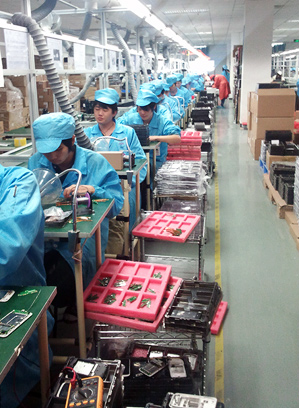
Yes, some guys you have never heard of are selling millions of smartphone enabled by IKEA-like chipset solutions that are assembled in optimized Chinese factories using off-the-shelf software. For years I was concerned about what I called the “supermarket brands,” that is, operator-labeled devices using white-box solutions. There were certainly some big hit devices with Vodafone and T-Mobile labels, more so in developing markets, but consumers did tend to migrate toward big brand names.

But when your neighbor, Frank, can start selling Android-based “Frank-o-phones” on Amazon.com, you had better find some more WOW to stuff into your devices. And some more adjacent business opportunity. For feature phone vendors, this is a trend which can really smart. Get ready to get down (in price).

What to do? Don't worry, I have solutions.

From MIT Tech Review Article:
“Cheap phones: Workers assemble $65 smartphones at Guo Wei Global Electronics, one of hundreds of small Chinese factories now building mobile computers.”


Friday, March 15, 2013

And the key mobile trend of week 11-2013 was...

sensors. Yes, sensors both inside and outside the device are growing wild like weeds.

For your consideration:

Samsung's new well-being related accessories >>

Samsung Galaxy S 4 sensors include gestures, barometer, thermometer, hygrometer (humidity), eye-tracking... >>

Ingestible sensors interact with handsets to get to the heart of the matter >>

Scanadu senses like a Star Trek Tricorder >>

Asthma data collected in Louisville via GPS, other sensors >>

Cool teaser of the Leap Motion 3D sensor >>


And there was a lot more sensor-related news around this week. Sensor expansion in smartphones and accessories including barometers, humidity sensors, thermometers, gestures, pedometers, breathalyzers, ECG monitors, allergy testers, more...

Barometers in smartphones? Yes! They're trending now. (Likely used to increase the accuracy of altitude measurements with the added potential of some crowd-sourced weather forecasting.) If you're a smartphone vendor, you're under pressure now to expand your senses. The heat is on:

Samsung gets a jump on competitors in sensor fusion potential:
Sensors in the new Samsung Galaxy S 4 include accelerometer, gyro, proximity, compass, barometer, temperature, humidity, gesture, eye-tracking...


Wednesday, December 26, 2012

Twenty trends for 2013 from Trend Hunter.

FROM TREND HUNTER >>

Trends for 2013 from trend-spotting firm Trend Hunter:


Thursday, December 20, 2012

iTube: mobile food allergen detector. I heart the potential of sensors + big data + clever algorithms.

GIZMAG STORY >>

Facebook tells us about old friends we may want to get back in touch with. LinkedIn tells us about jobs we may be interested in. Amazon tells us about books we may like. YouTube tells us about videos we may be interested in seeing. The supermarket even prints out customized coupons for ice cream I might be interested in trying. All this without asking.

For the most part, I find that such proactive marketing is rather helpful and amazingly accurate. But this shouldn't be surprising: there is a lot of big data and clever algorithms behind each notification.

And the potential for combining big data with proactive notification is just beginning. Let's call what we'll be seeing in the near future "big proactive." There will be more proactivity concerning individual healthcare and well-being as a history of data compiled from sensors overtime will calculate risks of disease. Sensors know the when, the what, the where, the weather. And going forward they will sniff out problems with our bodies and the air around us. Sensors will even be checking our food.

Here's an interesting project done at the University of California, Los Angeles called "iTube" which uses sensors to turn a smartphone into an allergen detector. By detecting food allergens such as gluten, peanuts and eggs, the smartphone can act to warn users of potential food risks.

I'm positive that sensors and big data will be big moving forward.


Friday, March 09, 2012

What the Metro North Indicator and the JetBlue Barometer are telling us: Print is running on empty.

When you find a reliable, real-world leading indicator, go with it.

Japanese teenagers and the general population of Singapore tend to be among the best gauges of the technology future. Unfortunately those are half a world away for me, so I have to learn to look local.

I find that the next best observable thing is busy commuting mid-level executives and their offspring. My part-time vantage point is watching suburbanites commuting into Manhattan. During peak commuting hours, many of these head downtown to Wall Street or to Madison Ave to play the ad game. During off-peak hours, their offspring head into the City to become cosmopolitans. My observation is that both groups have a good track record of being ahead of the technology adoption curve. That commute into the City is an early adopter zoo where one can safely observe technology-savvy species evolve before the eyes. The Metro North Indicator works.

Along the same vein, passengers on JetBlue and other lower-cost airlines tell their own tales. Couples with kids: that's where the action's at. See how they entertain. 3DS and tablets and laptops and smartphones and iPods.

A decade ago such observations made it clear to me that RIM and their BlackBerry line were about to go mainstream. On a series of peak adventure rides into Manhattan, I counted that 100% of the observable passengers were glued between BlackBerry screens and newspapers.

And now, about ten years later, a recent count brought the BlackBerry count to zero. The bring-your-own-device trend and worker demands has has led the iPhone and similar looking Android devices into the enterprise.

But what has become very clear is that the printed newspaper is on its last leg. I'm seeing very few newsprint readers these days and lots of eReaders (including tablets).

The Metro North Indicator is clear: print is on a one-way track to extinction.


Wednesday, October 05, 2011

European debt crisis? What about the growing European mobile crisis?

Don't get even, get angry (birds). And lots of them.

On September 29, Nokia announced the planned closure of their handset factory in Cluj, Romania. Manufacturing would be moved to other Nokia plants, especially those in China. To me this site closure was the exclamation mark on the de-Europeanization of the mobile industry. It's headed West. It's headed East. But it's not staying in the middle.

Back in the GSM heyday, in the mid-'90s, Europe became the center of the mobile world. Countries such as Sweden and Finland would brag of mobile penetration rates of greater than 25%, then 50% of the population.

And development happened on the Continent. Handset vendors and component suppliers of all sorts would gather in cities in France and the Netherlands, and other reasonably nice places across Europe to work on and influence wireless standardization, and mingle with the big European vendors and operators. There was Nokia, Ericsson, Siemens, Philips, Alcatel. There was ETSI and GSM. Those were glorious days for Europe. It was the center of the new mobile world as Europeans looked with pity and scorn at the U.S., a country with networks that could barely handle text messaging at the time. The U.S was in the the mobile dark ages.

I always liked to say, when it comes to mobile trends, Japanese teenagers do it first. But it truly happens big in Europe.

Now welcome to the new mobile century. Let's look at where things stand now:

  • All major smartphone platforms are from the U.S. (iOS, Android, WP). Symbian has thrown its hands up in defeat. (We could debate about RIM/QNX, Bada, here as well.)
  • Approximately 95% of handset industry profits are earned by vendors outside of Europe (using Q2 2011 numbers).
  • More than 80% of industry revenues are generated by non-European vendors. (I include half of Sony Ericsson's revenues in my calculations.)
  • Only 1.5 of the world's top-ten vendors are European (Nokia and Sony Ericsson.)
  • Standardization efforts are shifting to organizations such as W3C and IETF, as services take center stage.
  • About 95% of all handsets are manufactured outside of Europe.
  • European consumers upgrade their handsets at a slower pace than consumers in the U.S. and most key Asian countries.

    America has become the center of mobile software and services. There's Android, there's iOS, there's Windows Phone and Facebook and Google and Foursquare. And not only does Asia have key handset vendors such as Samsung, HTC, LG, they also have the world's largest mobile manufacturing based out of China. There's Foxconn (a Taiwan-based company). There's Compal (a Taiwan-based company).

    To be fair and clear, there certainly are fantastic on-going European success stories: ARM comes to mind. [I could also add Opera, Spotify, and Skype here.] And Nokia is still the world's largest handset maker in pure volume terms. And of course there's Finland-based Rovio, the maker of "Angry Birds."

    But it will take a lot of angry birds to make up for lost opportunities. It seems that mobile development has flown the coop.

    Is the sun setting on mobile Europe?


  • Saturday, October 01, 2011

    Speak now, or forever hold your piece. Is voice the new touch?

    Voice Actions for Android, Google Blog post >>

    It's time to speak up. It's time to be heard!

    Touch devices didn't storm onto the marketplace in 2007. Rather, there was a decade of light showers of touch. Devices of all sorts were breaking in consumers to a touch-input world: ticket machines at airports, ATMs, cars, palm pilots. It was slow going for a while, but now the majority of smartphones sold come with touch displays.

    After using verbal input in Google Maps on Android, I'm convinced the same is about to happen with voice input for phones. And like touch input, we've been broken into the concept of voice input for years now, shouting instructions into telephone menu systems, looking up names in feature phones, voice Googling on the PC, and even talking to cars.

    Most smartphone platforms currently support voice input of one sort or another, whether it be at the application or OS level. For the most part, it borders on amazing, especially for native speakers of a supported language. Try, for example, Nuance on iOS or Voice Actions on Android. Try voice searching (voicing?) for a complex address in Google Maps for mobile. You'll be sold.

    So Tellme something: are you ready to start talking?


    http://www.youtube.com/watch?v=HsI76lrvJt4

    Tuesday, September 13, 2011

    The real McCoy? AT&T appoints Chief Medical (Information) Officer. Is mobile healthcare for real now?

    Are you feeling good about the mobile healthcare market?

    At what point does the hype deliver? I've been hearing talk about mobile healthcare and well-being for more than a decade. And it makes perfect sense. Nearly 100% of the populations of most developed market are connected 100% of the time. Sensors of all sorts are cheap and getting cheaper. The enablers are in place. So, what happens now?

    I came across an AT&T press release about the creation of an executive position called “Chief Medical Information Officer.” The title is being filled by a physician with an MBA named Dr. Geeta Nayyar who will guide AT&T's “ForHealth” venture.

    Note that Sprint recently appointed a “chief healthcare executive” to create a strategy for that operator’s health venture. As telecommunications has become an integral part of the healthcare infratructure, operators are positioning themselves to become more than a bit pipe. The potential for value-added services is certainly somewhere for some player.

    As hardware and services become more commoditized, all mobile players should now ask themselves, do we need a top-level CMO (Chief Medical Officer)? Should all handset vendors have a central role for mobile health ventures, looking at the new opportunities along with the regulatory aspects of that market? Should infra vendors feel for their place in well-being? Are the APIs looking good to enable a new market?

    So, is it time to get well soon?


    AT&T Press Release >>

    Mobile healthcare. Is it now the real McCoy?


    "DiabetesManager:" keeping subscribers connected to life.

    Thursday, September 01, 2011

    Putting your company's futures planning on ice?
    Foresight now... or face extinction.


    Ask yourself: what refrigerator equivalent will come along and disrupt my industry... and kill my job?

    When you’re in the ice business, you had better be prepared for the invention of something like the fridge. Or face a cold, dark future.

    Disruptions happen. Just ask the once happy shareholders of the Knickerbocker Ice Company. Once a major supplier of frozen H2O to homes and businesses along the East Coast of the United States --and beyond--, Knickerbocker Ice had it all: an extensive and complex distribution network, fantastic supply chain, brand recognition, scale. And apparently a killer recipe for ice. Yes, Knickerbocker was flying high, and the company’s executives certainly never wanted the ice age to end.

    With company headquarters next to a crystal fresh-water lake very close to the Hudson River, and only 40 kilometers north of New York City, Knickerbocker Ice had smooth-sailing access to one of the world’s largest markets for ice. By the mid-1800s, Knickerbocker Ice had become a major utility. The company employed thousands at its peak, had ice warehouses (“icehouses”) up and down the East Coast, employed expert global ice traders, and established a brand name via the ubiquitous “iceman” who yelled “ice” from the city streets. Consumers would rush down to buy ice by price. “Give me 10 cents worth of ice, Tony.”

    Then along came electric utilities, a killer enabler as far as Knickerbocker Ice should have been concerned. Electric juice enabled refrigeration. And the fridge put an end to the profitable business of pushing ice. In 1924, the Knickerbocker Ice Company closed up shop. The ice age had come to an end for KIC.

    What does this have to do with trends in the wireless industry? I suppose nothing directly. But there is a lesson to be learned here. (Living through the current power outage in the New York region was my inspiration for this initial post, having to hunt down ice at various supermarkets.)

    Looking at the wireless industry, certain companies are flying high right now. Smartphone sales are exploding across the globe, consumers are cutting the cord, and the internet is headed toward mobile favoritism. Yes, things are hot in the wireless business these days. The device form factor is in place, service providers have sliced up the pie, and adjacent industries are beginning to melt into the mobile milieu.

    So, now is the time for mobile-related firms to prepare for the day when the mobile industry as we currently know it dries up. What will be the disruptive enabler? It’s a tough call.

    After years of following and reporting mobile developments for a major handset vendor, I plan to use this blog to share my observations and opinions a bit more widely. I enjoy trying to catch trends and spot opportunities. And uncover that coming disruptive enabler.

    Remember, every business goes cold at some point. And then it’s time to move on to the next hot thing.


    A Knickerbocker Ice factory:
    A great supply chain & logistics weren't enough to keep the firm afloat


    permalink to this entry