Friday, March 29, 2013
Tongue in cheek of the week: Sailor talk. Fantastic leaked footage! An average day in the life of T-Mobile USA's tough talkin' CEO.
I don't want to give too much away, but I do advise that you hide the kids, turn down the volume, and get ready for some tough street talk before watching the attached video. You see, you're about to see some footage of T-Mobile USA's CEO at work and at play. As we've learned by now, Mr. Legere calls it as he sees it. The gloves are coming off in the mobile biz. By George, what a fantastic tail! ROLL THE TAPE:


Is the home the next big mobile ecosystem? Samsung experience stores within BestBuy could cross Samsung white goods with Samsung CE products. Totally!
How can other smartphone vendors counter such potential?
CNET STORY >>
KEY MOBILE TRENDS: the mobile home, internet of things, retail
Smartphone vendors, get ready to swing for the fences, because you may need to make a run for home.
It's happening. White goods working together with smart phones. This is what partnerships between Ericsson & Electrolux and Nokia & Whirlpool were supposed to bring about more than 10 years ago. And then fade to black...
...and then slowly back to white, because here we go ago again. Is Samsung the vendor who can really bring it all together now? Washing machines and dryers talking to smartphones? Connected refrigerators which can suggest grocery lists and recipes based on inventory? Samsung dishwashers, televisions, scales, set-top boxes, security cameras, thermostats all working seamlessly together?
The home could be the next ecosystem domain. And now Samsung may be positioning itself to show off its complete solution by opening a series of Samsung experience stores within BestBuy. Stores within stores are nothing new, but Samsung's presence in America's largest electronics retailer could establish a permanent experience exhibit for the vendor, tying it altogether under one roof. (And for BestBuy, this could be a new business model to fight showcasing: become landlords.)
To be clear, Samsung is expected to initially use these in-store experience booths to highlight the Galaxy S 4, but if they are clever, which they sure are, they will be showing off so much more. This could be a great display of solidarity for Samsung and all its units. And a less expensive way to counter Apple's and Microsoft's retail stores.
So, that's the score. LG, Sony, Nokia/Microsoft, others: are you ready to bring it on home?
CNET STORY >>
KEY MOBILE TRENDS: the mobile home, internet of things, retail
Smartphone vendors, get ready to swing for the fences, because you may need to make a run for home.
It's happening. White goods working together with smart phones. This is what partnerships between Ericsson & Electrolux and Nokia & Whirlpool were supposed to bring about more than 10 years ago. And then fade to black...
...and then slowly back to white, because here we go ago again. Is Samsung the vendor who can really bring it all together now? Washing machines and dryers talking to smartphones? Connected refrigerators which can suggest grocery lists and recipes based on inventory? Samsung dishwashers, televisions, scales, set-top boxes, security cameras, thermostats all working seamlessly together?
The home could be the next ecosystem domain. And now Samsung may be positioning itself to show off its complete solution by opening a series of Samsung experience stores within BestBuy. Stores within stores are nothing new, but Samsung's presence in America's largest electronics retailer could establish a permanent experience exhibit for the vendor, tying it altogether under one roof. (And for BestBuy, this could be a new business model to fight showcasing: become landlords.)
To be clear, Samsung is expected to initially use these in-store experience booths to highlight the Galaxy S 4, but if they are clever, which they sure are, they will be showing off so much more. This could be a great display of solidarity for Samsung and all its units. And a less expensive way to counter Apple's and Microsoft's retail stores.
So, that's the score. LG, Sony, Nokia/Microsoft, others: are you ready to bring it on home?
Thursday, March 28, 2013
Will it trend? Remote opportunities. Flagship smartphones could need to morph into super smart TV remote controls on demand.
KEY MOBILE TRENDS: home, content, smart TV
Attention handset product managers and portfolio planners! Are you looking for the next must-have feature to stuff into your spanking new flagship smartphone? Well then, don't look forward, but rather, take a look back to some golden oldie consumer research from last century.
I remember in the '90s reading surveys of features people most desired in their handsets. Rather consistently --and perhaps somewhat facetiously-- at number one on these lists was not an embedded camera or touch screen supporting advanced browsing features. Nope. What people said they wanted most was an embedded bottle opener. I suppose the best bottle opener in the world is the one you have with you at the moment.
And next up on the list of requested features was an embedded television remote control.
It seemed a bit odd to me to replace a $1 device or a $5 device with a $500 device. Why wear down one of your most important and personal possessions to open a bottle of beer and/or do some channel surfing.
The bottle-opener concept didn't catch on, but now it looks like the smart TV remote control might just trend. I must admit that the use cases here do look compelling (please see the demo video below).
To be compatible with the current installed user base of television sets, this will require infrared. Rather retro indeed. (Some cable operators do offer dedicated smartphone apps which use data via WiFi to control programming and Microsoft's Xbox SmartGlass looks smooth as silk.)
Samsung starting putting the infra TV remote feature into their Galaxy Note phablets and now the feature has been added on their flagship smartphone, the Galaxy S 4. And HTC also added a built-in remote to their recently-released HTC One.
I don't know what an infrared blaster would add to bill of materials of a smartphone. I would think not much. Anyway, this is the type of finesse which makes for a great in-shop demo. Which smartphone vendor will be next? Sony, Nokia, ZTE, others: are you ready to work remotely?
Please remember: three makes trend, so stay tuned.
Related: Microsoft SmartGlass. Not an infra remote, but a nice control:
And then there's this...
For those looking to network with Chinese mobile players and understand the market: the kind producers of the Global Mobile Internet Conference 2013 and the extended "G-Trip" contacted me to share a 25% discount code with any readers who might wish to attend. You can register your attendance at http://beijing.thegmic.com/register/ and paste in the following code into the "discount code" section: GMIC-VQ9596MT
GWIC 2013. Be there. And see Tiananmen Square.

Attention handset product managers and portfolio planners! Are you looking for the next must-have feature to stuff into your spanking new flagship smartphone? Well then, don't look forward, but rather, take a look back to some golden oldie consumer research from last century.
I remember in the '90s reading surveys of features people most desired in their handsets. Rather consistently --and perhaps somewhat facetiously-- at number one on these lists was not an embedded camera or touch screen supporting advanced browsing features. Nope. What people said they wanted most was an embedded bottle opener. I suppose the best bottle opener in the world is the one you have with you at the moment.
And next up on the list of requested features was an embedded television remote control.
It seemed a bit odd to me to replace a $1 device or a $5 device with a $500 device. Why wear down one of your most important and personal possessions to open a bottle of beer and/or do some channel surfing.
The bottle-opener concept didn't catch on, but now it looks like the smart TV remote control might just trend. I must admit that the use cases here do look compelling (please see the demo video below).
To be compatible with the current installed user base of television sets, this will require infrared. Rather retro indeed. (Some cable operators do offer dedicated smartphone apps which use data via WiFi to control programming and Microsoft's Xbox SmartGlass looks smooth as silk.)
Samsung starting putting the infra TV remote feature into their Galaxy Note phablets and now the feature has been added on their flagship smartphone, the Galaxy S 4. And HTC also added a built-in remote to their recently-released HTC One.
I don't know what an infrared blaster would add to bill of materials of a smartphone. I would think not much. Anyway, this is the type of finesse which makes for a great in-shop demo. Which smartphone vendor will be next? Sony, Nokia, ZTE, others: are you ready to work remotely?
Please remember: three makes trend, so stay tuned.
HTC's One as a infrared-based controller:
Related: Microsoft SmartGlass. Not an infra remote, but a nice control:
And then there's this...

Photo via Pocket Lint
For those looking to network with Chinese mobile players and understand the market: the kind producers of the Global Mobile Internet Conference 2013 and the extended "G-Trip" contacted me to share a 25% discount code with any readers who might wish to attend. You can register your attendance at http://beijing.thegmic.com/register/ and paste in the following code into the "discount code" section: GMIC-VQ9596MT
GWIC 2013. Be there. And see Tiananmen Square.
Wednesday, March 27, 2013
Will it trend? The new T-Mobile subscriber non-contract. Is this the end of the 99¢ shop?

Back in the pre-smartphone days, friends and acquaintances in the U.S. would sometimes ask me how handset vendors like Nokia and Motorola could afford to sell phones for one dollar. Of course, the answer is they can't and don't: subscribers are actually entering into an amortization scheme with the operator. Unlike in many European and Asian markets, few Americans ever considered separating the device from the service.
Might the American market now be shifting to mimic the old European ways? America's #4 wireless operator, T-Mobile, with little to lose, is taking a stab at sparking that type of change.
T-Mobile USA is positioning itself as the new bad boy of the U.S. mobile biz with one heck of an anti-establishment attitude. With a few cuss words here and there, T-Mobile USA's rather new CEO, John Legere, insists that it takes an industry outsider like him to shake things up a bit.
T-Mobile is moving away from the industry-standard two-year contact, and pushing month-to-month voice and data at very competitive prices. But the bigger point here is separating the price of the device from the cost of the service. This does make the device financing more transparent with a clear breakdown of hardware and service costs. (T-Mobile calls each payment of the installment plan a "phone fee" which is still a bit misleading in my opinion.)
T-Mobile USA President & CEO, John Legere: No more annual service contracts, all new plans, unlimited, LTE, unlimited 4G FaceTime...
So, are the days of penny candy numbered?

Predictive intelligent personal assistants are all the rage. Windows Phone, you need something like this Now.
Google's Now, Apple's Siri, Samsung's S Voice. Next: Grokr, Mailbox, Tempo, Sherpa and more. Predictive personal intelligent digital assistants seem to be all the rage. Is this a big app gap for Windows Phone?
UPDATE: Someone informed me (thanks AC) of the availability of a voice-input digital assistant app called Maluuba which is available for Windows Phone 8.
MIT Tech Review Story >>
Sherpa Pages >>
Tempo Pages >>
KEY MOBILE TRENDS: digital/virtual assistants, predictive services, location-based services
Predictive services aren't cutting edge per se. Amazon, for example, is kind enough to remind us, usually with great accuracy, what we want to buy and for whom and when. Many connected navigation devices & services know enough to automatically re-route us when there is trouble ahead. And TiVo uses some smart algorithms to do some smart guessing when it comes to pre-choosing TV content. Even home thermostats are getting in on the act.
But now, smartphones are getting ahead of the game with more advanced predictive applications using clever data-mining techniques which cross on-device info with cloud-based data. Newer applications like Tempo and Sherpa are actively promoting themselves as "predictive intelligent" services with the intent of being proactive "to keep you one step ahead." Have a flight scheduled in your calendar or e-mail? Apps will check if it is leaving on-time, check the weather, and the volume of traffic on the way to the airport. It could offer to dial the number of anyone who you might be meeting at your destination in case of delays, and even reserve a table.
In many ways I see this as more of a UI evolution toward natural user interfaces with a touch of machine-to-machine services thrown in. Of course there are very natural input methods like voice in Apple's Siri and open-text input like Google's "quick add." But the ability of some of these newer, more advanced applications to work with semantics and break information out of silos could raise users' expectations going forward. Data, services, apps, and connectivity are being folded much deeper into the device's user interface. This isn't just location-based voice search. This has the potential to be pretty smooth.
Oddly enough, the platform vendor which gave the world one of the best known smart agents ever, Clippy, appears to be quite absent in this space. To the best of my knowledge, there's nothing quite like Tempo for Microsoft's Windows Phone. To be fair, Nokia does have some great contextual-based services for Windows Phone and there are a few other interesting innovative proactive-like apps for the platform (update: like Maluuba). In addition, I must confess that I haven't seen any usage statistics for any of this: it could be there won't be much demand. The consumer is always the greatest unknown variable in business-model equations.
Nonetheless, I wouldn't take the risk of leaving this gap. I would say that Windows Phone should check its calendar: the platform needs something like this soon if it wants to keep up with a potential experience shift. Be proactive with proactivity.
[Update: another term I was kindly informed of by AC is "virtual assistant."]
Tempo:
Sherpa:

Google Now:
Maluuba for Android and Windows Phone 8:
UPDATE: Someone informed me (thanks AC) of the availability of a voice-input digital assistant app called Maluuba which is available for Windows Phone 8.
MIT Tech Review Story >>
Sherpa Pages >>
Tempo Pages >>
KEY MOBILE TRENDS: digital/virtual assistants, predictive services, location-based services
Predictive services aren't cutting edge per se. Amazon, for example, is kind enough to remind us, usually with great accuracy, what we want to buy and for whom and when. Many connected navigation devices & services know enough to automatically re-route us when there is trouble ahead. And TiVo uses some smart algorithms to do some smart guessing when it comes to pre-choosing TV content. Even home thermostats are getting in on the act.
But now, smartphones are getting ahead of the game with more advanced predictive applications using clever data-mining techniques which cross on-device info with cloud-based data. Newer applications like Tempo and Sherpa are actively promoting themselves as "predictive intelligent" services with the intent of being proactive "to keep you one step ahead." Have a flight scheduled in your calendar or e-mail? Apps will check if it is leaving on-time, check the weather, and the volume of traffic on the way to the airport. It could offer to dial the number of anyone who you might be meeting at your destination in case of delays, and even reserve a table.
In many ways I see this as more of a UI evolution toward natural user interfaces with a touch of machine-to-machine services thrown in. Of course there are very natural input methods like voice in Apple's Siri and open-text input like Google's "quick add." But the ability of some of these newer, more advanced applications to work with semantics and break information out of silos could raise users' expectations going forward. Data, services, apps, and connectivity are being folded much deeper into the device's user interface. This isn't just location-based voice search. This has the potential to be pretty smooth.
Oddly enough, the platform vendor which gave the world one of the best known smart agents ever, Clippy, appears to be quite absent in this space. To the best of my knowledge, there's nothing quite like Tempo for Microsoft's Windows Phone. To be fair, Nokia does have some great contextual-based services for Windows Phone and there are a few other interesting innovative proactive-like apps for the platform (update: like Maluuba). In addition, I must confess that I haven't seen any usage statistics for any of this: it could be there won't be much demand. The consumer is always the greatest unknown variable in business-model equations.
Nonetheless, I wouldn't take the risk of leaving this gap. I would say that Windows Phone should check its calendar: the platform needs something like this soon if it wants to keep up with a potential experience shift. Be proactive with proactivity.
[Update: another term I was kindly informed of by AC is "virtual assistant."]
Tempo:
Sherpa:
Google Now:
Maluuba for Android and Windows Phone 8:
Tuesday, March 26, 2013
Wearable computing for hygiene behavior tracking.
Medgadget Story >>
"Please Note: Employees must wash hands... and wear these special behavior-tracking wrist bands."
On one hand I see this concept as a good idea, on the other hand as rather intrusive.
The concept of gadgets tracking our healthcare habits isn't so strange any longer, and it will get less so going forward. Many electric toothbrushes, for example, monitor the amount of time the user spends brushing and some even go further, tracking such things as pressure on the gums. Smartphone apps can record the level of daily activity and prod the owner to get moving, and I've read about specialized computer mice which can check the user's stress levels via the fingertip and advise accordingly.
But now the same technical components can be used by employers to monitor as well as change workers' behavior. Here's a wrist-worn device from a startup called IntelligentM which can track employees seven days per week, 24 hours per day. The device works using accelerometers and RFID to track where a hospital employee is and how properly and how often they wash their hands.
Is this an example of the use of sensors for good hygiene instead of evil? I can see the argument given the stats mentioned in the video below. But, on the other hand, it is a bit Big Brother like. Just hope you don't get called to hospital room 101 for employee evaluation.
"Please Note: Employees must wash hands... and wear these special behavior-tracking wrist bands."
On one hand I see this concept as a good idea, on the other hand as rather intrusive.
The concept of gadgets tracking our healthcare habits isn't so strange any longer, and it will get less so going forward. Many electric toothbrushes, for example, monitor the amount of time the user spends brushing and some even go further, tracking such things as pressure on the gums. Smartphone apps can record the level of daily activity and prod the owner to get moving, and I've read about specialized computer mice which can check the user's stress levels via the fingertip and advise accordingly.
But now the same technical components can be used by employers to monitor as well as change workers' behavior. Here's a wrist-worn device from a startup called IntelligentM which can track employees seven days per week, 24 hours per day. The device works using accelerometers and RFID to track where a hospital employee is and how properly and how often they wash their hands.
Is this an example of the use of sensors for good hygiene instead of evil? I can see the argument given the stats mentioned in the video below. But, on the other hand, it is a bit Big Brother like. Just hope you don't get called to hospital room 101 for employee evaluation.
The vital importance of removing the "i" from innovation, instinct, intuition, inspiration, invention, insight, ideas... Please help fight the "I Effect."
When thinking about the next big thing, please think about somebody else for a change.
Yes, change is hard enough to push through the system as is. Don't stuff up the channels of progress with your own stuffiness.
During my career, I have seen many good product ideas dismissed because of the painful "I Effect." You see, when it comes to evaluating business ideas, often a fantastically homogeneous group of individuals sit around a table and point out how they themselves would never need such a device or service.
Most world-shattering inventions have suffered at least one such "I" dismissal. The computer in the home, the wireless radio box, talkie movies, television, and then color television.
I've certainly made the mistake myself several times. I once said that there is no opportunity in ringtones because "I would never buy one." And I've made other miserably wrong forecasts based on what I personally thought was annoying or cool. But I've learned. And so can you.
Almost 10 years ago I saw a very excellent Facebook-like service proposal get dismissed by an executive on the grounds that it was something the executive said he didn't need. "I don't understand it, and I don't think I would ever use it." That's not a verbatim quote: the real quote was even more brutal.
It's not easy to remove the "i" from the innovation equation, but I do suggest that your try. Remember, you can't spell myopia without "my." So fight it with fury. For example, when attending any brainstorming session, interrupt anyone who talks constantly about their own day-to-day experiences. You probably know the type already: "Well, what I do is when I get home I turn on..." Or, "I would never use such a thing."
I acknowledge that are times when anecdotal evidence mirrors general behavior. But I have met very few individuals who have the instinctual talent to really understand what ports well to the larger audience.
One reason so many new products & service come from young minds working out of old garages is because in big companies, go-no-go decisions are ultimately made by out-of-touch managers working closely with out-of-touch executives.
When it comes to innovation, please check your I sight and do make sure that you're not getting in the way.
Yes, change is hard enough to push through the system as is. Don't stuff up the channels of progress with your own stuffiness.
During my career, I have seen many good product ideas dismissed because of the painful "I Effect." You see, when it comes to evaluating business ideas, often a fantastically homogeneous group of individuals sit around a table and point out how they themselves would never need such a device or service.
Most world-shattering inventions have suffered at least one such "I" dismissal. The computer in the home, the wireless radio box, talkie movies, television, and then color television.
I've certainly made the mistake myself several times. I once said that there is no opportunity in ringtones because "I would never buy one." And I've made other miserably wrong forecasts based on what I personally thought was annoying or cool. But I've learned. And so can you.
Almost 10 years ago I saw a very excellent Facebook-like service proposal get dismissed by an executive on the grounds that it was something the executive said he didn't need. "I don't understand it, and I don't think I would ever use it." That's not a verbatim quote: the real quote was even more brutal.
It's not easy to remove the "i" from the innovation equation, but I do suggest that your try. Remember, you can't spell myopia without "my." So fight it with fury. For example, when attending any brainstorming session, interrupt anyone who talks constantly about their own day-to-day experiences. You probably know the type already: "Well, what I do is when I get home I turn on..." Or, "I would never use such a thing."
I acknowledge that are times when anecdotal evidence mirrors general behavior. But I have met very few individuals who have the instinctual talent to really understand what ports well to the larger audience.
One reason so many new products & service come from young minds working out of old garages is because in big companies, go-no-go decisions are ultimately made by out-of-touch managers working closely with out-of-touch executives.
When it comes to innovation, please check your I sight and do make sure that you're not getting in the way.

Sunday, March 24, 2013
Insults are the sincerest form of flattery. And one of the surest indications of success. Why execs should shut up.
Mobile executives can say the meanest things about their competitors' products. But for those product managers on the receiving end of such pejoratives, I have good news for you: there tends to be a near 100% negative correlation to negative comments.
Yes, you know that you really hit a nerve when some top-level manager at a competing company dismisses your product as a nonstarter. And one of the absolute greatest leading indicators of success is when an executive mentions your impending failure during a quarterly results call. You should be so lucky to get that. (My advice is to humble it out on both ends.)
Here is a limited selection of some entertaining opinions, past and present. There are more, but let's start with the obvious. I'll call this list the top-ten failed failure forecasts. (Give it time.)
- Microsoft's Steve Ballmer, 2007: The iPhone has “no chance” of gaining significant market share.
- Microsoft's Steve Ballmer, 2011: You need to be a “computer scientist” to use an Android smartphone. (Android now has around 70% platform share, Windows Phone 3%.)
- Nokia CEO Olli-Pekka Kallasvuo, 2008: Apple's iPhone is a “niche” product.
- Nokia Executive Vice President Anssi Vanjoki, 2009: The iPhone has a “toy camera.”
- Apple's Tim Cook, Jan 2011: “We're not that worried about” Android tablets. (Apple had around 80% market share of tablets at the time.)
- Apple's Tim Cook: We're not worried about Amazon's Kindle.
- Apple's Phil Schiller, March 2013: “...Samsung Galaxy S4 is being rumored to ship with an OS that is nearly a year old. Customers will have to wait to get an update.” Android is fragmented, unsafe, et cetera, et cetera.
- HTC Chief Marketing Officer, Benjamin Ho, March 2013: Samsung's Galaxy S 4 “is more of the same.” (Early indicators show that S 4 sales are much stronger than the S III, which in itself was one of the best-selling smartphones ever.)
- BlackBerry CEO Thorsten Heins, March 2013: Apple's iPhone/iOS is “five years out of date.”
- And finally, here is some good news for Google's Chrome OS, criticism from Ballmer:
So, how silly will Mr. Ballmer's opinion look in five years from now?
Yes, you know that you really hit a nerve when some top-level manager at a competing company dismisses your product as a nonstarter. And one of the absolute greatest leading indicators of success is when an executive mentions your impending failure during a quarterly results call. You should be so lucky to get that. (My advice is to humble it out on both ends.)
Here is a limited selection of some entertaining opinions, past and present. There are more, but let's start with the obvious. I'll call this list the top-ten failed failure forecasts. (Give it time.)
- Microsoft's Steve Ballmer, 2007: The iPhone has “no chance” of gaining significant market share.
- Microsoft's Steve Ballmer, 2011: You need to be a “computer scientist” to use an Android smartphone. (Android now has around 70% platform share, Windows Phone 3%.)
- Nokia CEO Olli-Pekka Kallasvuo, 2008: Apple's iPhone is a “niche” product.
- Nokia Executive Vice President Anssi Vanjoki, 2009: The iPhone has a “toy camera.”
- Apple's Tim Cook, Jan 2011: “We're not that worried about” Android tablets. (Apple had around 80% market share of tablets at the time.)
- Apple's Tim Cook: We're not worried about Amazon's Kindle.
- Apple's Phil Schiller, March 2013: “...Samsung Galaxy S4 is being rumored to ship with an OS that is nearly a year old. Customers will have to wait to get an update.” Android is fragmented, unsafe, et cetera, et cetera.
- HTC Chief Marketing Officer, Benjamin Ho, March 2013: Samsung's Galaxy S 4 “is more of the same.” (Early indicators show that S 4 sales are much stronger than the S III, which in itself was one of the best-selling smartphones ever.)
- BlackBerry CEO Thorsten Heins, March 2013: Apple's iPhone/iOS is “five years out of date.”
- And finally, here is some good news for Google's Chrome OS, criticism from Ballmer:
So, how silly will Mr. Ballmer's opinion look in five years from now?
LifeBEAM SMART helmet. Another example of wearable data-collecting devices.
Indiegogo pages >>
Here's an interesting project I found on Indiegogo's site: a bicycle helmet which collects heart rate data. The helmet can feed the data to a smartphone using Bluetooth. As the helmet also has an accelerometer, the project owners are looking into the possibility of crash detection. Since bikes or helmets don't have airbags, I am not so sure what good a crash detection feature would do, but perhaps at some points sports clothing will get more protective.
In some ways this could be considered a solution looking for a problem to solve which already has a solution: Bluetooth-enabled heart-rate monitors already exist, and so do helmets. I suppose it could be argued that this saves the user a bit of hassle. But the point here is that sensors such as heart-rate monitors are being "sewn" into other wearable devices.
This on-going collection of vital data has great potential. Let's get it on.

Here's an interesting project I found on Indiegogo's site: a bicycle helmet which collects heart rate data. The helmet can feed the data to a smartphone using Bluetooth. As the helmet also has an accelerometer, the project owners are looking into the possibility of crash detection. Since bikes or helmets don't have airbags, I am not so sure what good a crash detection feature would do, but perhaps at some points sports clothing will get more protective.
In some ways this could be considered a solution looking for a problem to solve which already has a solution: Bluetooth-enabled heart-rate monitors already exist, and so do helmets. I suppose it could be argued that this saves the user a bit of hassle. But the point here is that sensors such as heart-rate monitors are being "sewn" into other wearable devices.
This on-going collection of vital data has great potential. Let's get it on.
Saturday, March 23, 2013
EyeVerify. With retinal scanning in phones, mobile biometric authentication is looking serious.
PC MAG STORY >>
COMPANY WEBSITE >>
I must confess that the term "eyeprint" is new to me, but like any good pupil, I am always looking to learn.
While the term doesn't even have a wikipedia page yet (as of this writing), the use of retinal scans for identification is not something new. Military establishments and intelligence & law enforcement agencies across the globe have been using retinal-scanning authentication for years, and we know that employees of The United Federation of Planets will be using the technology many years from now.
But is retinal scanning about to go mainstream and mobile? A number of firms are working on bringing the technology to smartphone platforms. By using either the front-facing or back camera on a device, software could use the available hardware on the device to scan the user's retina for authentication either alone or in unison with other identifiers.
Here is a demo/pitch from a company called EyeVerify. At first look, this process seems a bit awkward for common tasks, like opening the lock screen. But biometrics in smartphones has certainly been creeping along with facial, fingerprint, voice recognition implemented in devices. And soon some company will come along and move biometrics from slightly gimmicky to truly magical. It's something to look forward.

COMPANY WEBSITE >>
I must confess that the term "eyeprint" is new to me, but like any good pupil, I am always looking to learn.
While the term doesn't even have a wikipedia page yet (as of this writing), the use of retinal scans for identification is not something new. Military establishments and intelligence & law enforcement agencies across the globe have been using retinal-scanning authentication for years, and we know that employees of The United Federation of Planets will be using the technology many years from now.
But is retinal scanning about to go mainstream and mobile? A number of firms are working on bringing the technology to smartphone platforms. By using either the front-facing or back camera on a device, software could use the available hardware on the device to scan the user's retina for authentication either alone or in unison with other identifiers.
Here is a demo/pitch from a company called EyeVerify. At first look, this process seems a bit awkward for common tasks, like opening the lock screen. But biometrics in smartphones has certainly been creeping along with facial, fingerprint, voice recognition implemented in devices. And soon some company will come along and move biometrics from slightly gimmicky to truly magical. It's something to look forward.
Friday, March 22, 2013
Tongue in cheek of the week: Nokia demos its amazing new strategy to increase market share!
Vendor plans to up its market share one unit at a time. Story at 11.
Talk about a well-grounded discussion. Talk about throwing caution into the wind!
Sure, it might take a while, but iPhone, you're going down using this new strategic method! (Please note that this amazing new business process is patent pending. Copy at your own risk of litigation.)
I can imagine that some of you out there might say this looks rather desperate, but let's give credit to Nokia's CEO, Stephen Elop, as he stands his ground showing that Nokia's market share has reached the floor and it will go down no more.
NOTE: When I have been recommending that smartphone vendors find new business opportunities, I never even thought of comedy.
Talk about a well-grounded discussion. Talk about throwing caution into the wind!
Sure, it might take a while, but iPhone, you're going down using this new strategic method! (Please note that this amazing new business process is patent pending. Copy at your own risk of litigation.)
I can imagine that some of you out there might say this looks rather desperate, but let's give credit to Nokia's CEO, Stephen Elop, as he stands his ground showing that Nokia's market share has reached the floor and it will go down no more.
NOTE: When I have been recommending that smartphone vendors find new business opportunities, I never even thought of comedy.
And the key mobile trend of week 12-2013 is...
commoditization.
KEY MOBILE TREND: commoditization, MediaTek
Sorry smartphone industry, you are not going to escape the fate of just about very other segment of the consumer electronics biz.
Relying on the value of the brand? That will certainly buy you some time. But when all devices look and act alike, pricing power fades, margins thin out, and market shares shift. Just look at the leading U.S. television set maker, Vizio. Who? That's my point exactly.
Some recent stories for your consideration:
- Eric Schmidt: the $70 smartphone is almost here >>
- BLU Products quad-core, dual-SIM Androd for $229, plus other low-costers >>
- MediaTek to see revenues rally 50% sequentially in March (sorry, no free link, but believe it).
- Neo's N003 is “world’s cheapest 1080p 5-inch smartphone” unlocked at $145 >>
- MIT Tech Review: “Apple and Samsung, beware. Practically anyone can make a smartphone these days.” >>
Yes, some guys you have never heard of are selling millions of smartphone enabled by IKEA-like chipset solutions that are assembled in optimized Chinese factories using off-the-shelf software. For years I was concerned about what I called the “supermarket brands,” that is, operator-labeled devices using white-box solutions. There were certainly some big hit devices with Vodafone and T-Mobile labels, more so in developing markets, but consumers did tend to migrate toward big brand names.
But when your neighbor, Frank, can start selling Android-based “Frank-o-phones” on Amazon.com, you had better find some more WOW to stuff into your devices. And some more adjacent business opportunity. For feature phone vendors, this is a trend which can really smart. Get ready to get down (in price).
What to do? Don't worry, I have solutions.
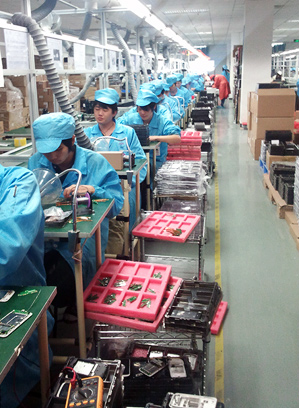
From MIT Tech Review Article:
“Cheap phones: Workers assemble $65 smartphones at Guo Wei Global Electronics, one of hundreds of small Chinese factories now building mobile computers.”
KEY MOBILE TREND: commoditization, MediaTek
Sorry smartphone industry, you are not going to escape the fate of just about very other segment of the consumer electronics biz.
Relying on the value of the brand? That will certainly buy you some time. But when all devices look and act alike, pricing power fades, margins thin out, and market shares shift. Just look at the leading U.S. television set maker, Vizio. Who? That's my point exactly.
Some recent stories for your consideration:
- Eric Schmidt: the $70 smartphone is almost here >>
- BLU Products quad-core, dual-SIM Androd for $229, plus other low-costers >>
- MediaTek to see revenues rally 50% sequentially in March (sorry, no free link, but believe it).
- Neo's N003 is “world’s cheapest 1080p 5-inch smartphone” unlocked at $145 >>
- MIT Tech Review: “Apple and Samsung, beware. Practically anyone can make a smartphone these days.” >>
Yes, some guys you have never heard of are selling millions of smartphone enabled by IKEA-like chipset solutions that are assembled in optimized Chinese factories using off-the-shelf software. For years I was concerned about what I called the “supermarket brands,” that is, operator-labeled devices using white-box solutions. There were certainly some big hit devices with Vodafone and T-Mobile labels, more so in developing markets, but consumers did tend to migrate toward big brand names.
But when your neighbor, Frank, can start selling Android-based “Frank-o-phones” on Amazon.com, you had better find some more WOW to stuff into your devices. And some more adjacent business opportunity. For feature phone vendors, this is a trend which can really smart. Get ready to get down (in price).
What to do? Don't worry, I have solutions.
From MIT Tech Review Article:
“Cheap phones: Workers assemble $65 smartphones at Guo Wei Global Electronics, one of hundreds of small Chinese factories now building mobile computers.”
HP holograms displays.
MIT Tech Review Story >>
KEY MOBILE TRENDS: holograms, displays, components
The long, long-term future of displays is holograms. Hologram move theaters, hologram televisions, hologram computers, even hologram mobiles.
Just like multi-touch input, some smartphone vendor will come along some day and shift the market in a new direction. This is a vision.
Here is some hologram display research from HP:
KEY MOBILE TRENDS: holograms, displays, components
The long, long-term future of displays is holograms. Hologram move theaters, hologram televisions, hologram computers, even hologram mobiles.
Just like multi-touch input, some smartphone vendor will come along some day and shift the market in a new direction. This is a vision.
Here is some hologram display research from HP:
The internet of bins. Connected waste bins tell when it's time to take out the trash. Truck roll avoidance!
PR/STORY >>
KEY MOBILE TRENDS: M2M, internet of things
Three more words of fantastic opportunity I would like to share this week: truck roll avoidance.
Talk to managers at service-based companies or municipalities about truck rolls and they'll cringe. Talk to them about how they could avoid truck rolls and their ear will perk up. Really.
A truck roll is when some sort of service worker is dispatched to a remote location. It could be a cable repairman, a municipal worker, a nurse. There's the wasted time of transporting the worker, the depreciation on the vehicle, and the potential for some sort of mishap. I learned about the importance of truck rolls when working at Nokia's set-top box unit: develop a set-top box that could find a way around a truck roll and operators would listen.
Here is a great example of the use of the internet of things to minimize truck rolls: connected municipal trash bins which know how full they are and actively report their status. Cities across the globe are getting smart to such ideas of smarter things.
We've all been hearing about connected things and machine-to-machine communications for the past decade now. But it's really happening. Don't throw away this opportunity.
Less wasted time:
KEY MOBILE TRENDS: M2M, internet of things
Three more words of fantastic opportunity I would like to share this week: truck roll avoidance.
Talk to managers at service-based companies or municipalities about truck rolls and they'll cringe. Talk to them about how they could avoid truck rolls and their ear will perk up. Really.
A truck roll is when some sort of service worker is dispatched to a remote location. It could be a cable repairman, a municipal worker, a nurse. There's the wasted time of transporting the worker, the depreciation on the vehicle, and the potential for some sort of mishap. I learned about the importance of truck rolls when working at Nokia's set-top box unit: develop a set-top box that could find a way around a truck roll and operators would listen.
Here is a great example of the use of the internet of things to minimize truck rolls: connected municipal trash bins which know how full they are and actively report their status. Cities across the globe are getting smart to such ideas of smarter things.
We've all been hearing about connected things and machine-to-machine communications for the past decade now. But it's really happening. Don't throw away this opportunity.
Less wasted time:
Thursday, March 21, 2013
Carbon copy. Near-field transfers of up to one terabit per second using graphene antennas. Bluetooth, eat your heart out.
Bluetooth 3: up to 24 Mbit/s.
"Graphene transfer" beta: up to 100 terabits/s.
MIT Technology Review Story >>
Not that he is still looking for career advice, but if I were to give Ben Braddock, the protagonist in the film "The Graduate," a one-word lecture on what to do with his life, it would be "graphene." Yes, graphene. Think about it at least.
So please run this story by your nanotech materials division. What!? Your company doesn't have a nanotechology materials unit? Well, a nonotech group then? A small team? An in-house expert? A hobbyist? No? Then you'd better get one.
So, researchers at Georgia Tech are working on a method of making wireless transfers of up to one terabit per second between devices by using graphene antennas. At such speeds, in a few seconds, you could shoot over a few high-definition movies to your friend and then in return, borrow a library of music. The range of such transfers is only up to a meter (a yard) or so. But get this: at shorter ranges, much faster transfers could be possible, say around 100 terabits per second. And remember how excited we were about Bluetooth. And then sharing pics via NFC coupling?
While it has its limitations and its problems, graphene is looking like an amazing enabler in so many ways. This one-atom-thick layer of carbon rolled up into "nanotubes" can take on many different roles depending upon the angle of the bond and the diameter of the roll. Graphene is super light, super strong, and simply super.
I realize this is nothing you will find in the next iPhone or Lumia (but please prove me wrong Apple or Nokia), but the goal of my blog is to provide exposure for longer-term technology trends and industry shifts. And when it literally comes to shaping the future, it's likely that nanotech-related developments will be in the center. Someday we will really see interesting new device form factors, tiny embedded computers, and super tough devices thanks to advancements in nanotechnology.
Huge advancements are coming in the tiniest of ways. Graphene, the plastics of the new century.
"21st Century story update:
four words of career advice: nanotechnology-related material sciences."
Carbon copy: Researchers are working on using atoms of carbon for super transfers:

For those looking to network with Chinese mobile players and understand the market: the kind producers of the Global Mobile Internet Conference 2013 and the extended "G-Trip" contacted me to share a 25% discount code with any readers who might wish to attend. You can register your attendance at http://beijing.thegmic.com/register/ and paste in the following code into the "discount code" section: GMIC-VQ9596MT
GWIC 2013. Be there. And see see Tiananmen Square.
"Graphene transfer" beta: up to 100 terabits/s.
MIT Technology Review Story >>
Not that he is still looking for career advice, but if I were to give Ben Braddock, the protagonist in the film "The Graduate," a one-word lecture on what to do with his life, it would be "graphene." Yes, graphene. Think about it at least.
So please run this story by your nanotech materials division. What!? Your company doesn't have a nanotechology materials unit? Well, a nonotech group then? A small team? An in-house expert? A hobbyist? No? Then you'd better get one.
So, researchers at Georgia Tech are working on a method of making wireless transfers of up to one terabit per second between devices by using graphene antennas. At such speeds, in a few seconds, you could shoot over a few high-definition movies to your friend and then in return, borrow a library of music. The range of such transfers is only up to a meter (a yard) or so. But get this: at shorter ranges, much faster transfers could be possible, say around 100 terabits per second. And remember how excited we were about Bluetooth. And then sharing pics via NFC coupling?
While it has its limitations and its problems, graphene is looking like an amazing enabler in so many ways. This one-atom-thick layer of carbon rolled up into "nanotubes" can take on many different roles depending upon the angle of the bond and the diameter of the roll. Graphene is super light, super strong, and simply super.
I realize this is nothing you will find in the next iPhone or Lumia (but please prove me wrong Apple or Nokia), but the goal of my blog is to provide exposure for longer-term technology trends and industry shifts. And when it literally comes to shaping the future, it's likely that nanotech-related developments will be in the center. Someday we will really see interesting new device form factors, tiny embedded computers, and super tough devices thanks to advancements in nanotechnology.
Huge advancements are coming in the tiniest of ways. Graphene, the plastics of the new century.
"21st Century story update:
four words of career advice: nanotechnology-related material sciences."
Carbon copy: Researchers are working on using atoms of carbon for super transfers:
For those looking to network with Chinese mobile players and understand the market: the kind producers of the Global Mobile Internet Conference 2013 and the extended "G-Trip" contacted me to share a 25% discount code with any readers who might wish to attend. You can register your attendance at http://beijing.thegmic.com/register/ and paste in the following code into the "discount code" section: GMIC-VQ9596MT
GWIC 2013. Be there. And see see Tiananmen Square.
Subscribe to:
Posts (Atom)